ARTIFICIAL INTELLIGENCE
INTRODUCTION

In computer science, artificial intelligence (AI), sometimes called machine intelligence, is intelligence demonstrated by machines, in contrast to the natural intelligence displayed by humans and other animals. Computer science defines AI research as the study of "intelligent agents": any device that perceives its environment and takes actions that maximize its chance of successfully achieving its goals.
More in detail, Kaplan and Haenlein define AI as "a systems ability to correctly interpret external data, to learn from such data, and to use those learnings to achieve specific goals and tasks through flexible adaptation". colloquially, the term "artificial intelligence" is applied when a machine mimics "cognitive" functions that humans associate with other human minds, such as "learning" and "problem solving".
BRIEF HISTORY

APPLICATIONS OR USES OF AI :-
AI is important because it can help solve immensely difficult issues in various industries, such as entertainment, education, health, commerce, transport, and utilities. AI applications are:-
1. Healthcare
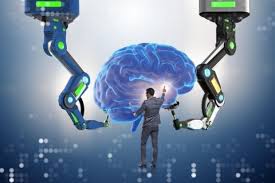
AI and ML technology has been particularly useful in the healthcare industry because it generates massive amounts of data to train with and enables algorithms to spot patterns faster than human analysts.
2. Entertainment




INTRODUCTION
In computer science, artificial intelligence (AI), sometimes called machine intelligence, is intelligence demonstrated by machines, in contrast to the natural intelligence displayed by humans and other animals. Computer science defines AI research as the study of "intelligent agents": any device that perceives its environment and takes actions that maximize its chance of successfully achieving its goals.
More in detail, Kaplan and Haenlein define AI as "a systems ability to correctly interpret external data, to learn from such data, and to use those learnings to achieve specific goals and tasks through flexible adaptation". colloquially, the term "artificial intelligence" is applied when a machine mimics "cognitive" functions that humans associate with other human minds, such as "learning" and "problem solving".
BRIEF HISTORY

- DARTMOUTH CONFERENCE ( 1956) : the birth of AI. The proposal for the conference included this assertion: "every aspect of learning or any other feature of intelligence can be so precisely described that a machine can be made to simulate it".
- THE GOLDEN YEARS, (1956-1974), There were many successful programs and new directions: Natural language Understanding ( first AI program to use a semantic net ), micro-worlds, Neural Networks.
- THE FIRST AI WINTER AI ( 1974-1980 ). AI was subject to critiques and financial setbacks. AI researchers had failed to appreciate the difficulty of the problems they faced. Their tremendous optimism had raised expectations impossibly high, and when the promised results failed to materialize, funding for AI disappeared.
- BOOM: IN THE 1980s ( 1987 ) a form of AI program called "expert systems" was adopted by corporations around the world and knowledge became the focus of mainstream AI research. in those same years, the Japanese government aggressively funded AI with its fifth generation computer project.
- THE SECOND AI WINTER ( 1987-1993 ). The business community's fascination with AI rose and fell in the 80s in the classic pattern of an economic bubble. The collapse was in the perception of AI by government agencies and investors - the field continued to make advances despite the criticism.
APPLICATIONS OR USES OF AI :-
1. Healthcare
AI and ML technology has been particularly useful in the healthcare industry because it generates massive amounts of data to train with and enables algorithms to spot patterns faster than human analysts.
2. Entertainment
A familiar application of AI in everyday life is seen with services like Netflix or Amazon, wherein ML algorithms analyze the user's activity and compare it with that of other users to determine which shows or products to recommend.
3.Finance
Financial services companies use AI - based natural language processing tools to analyze brand sentiment from social media platforms and provide actionable advice.
Investment companies like Aidya and Nomura securities use AI algorithms to conduct trading autonomously and robo-traders to conduct high frequency trading for greater profits, respectively.
Fraud detection is an important application of AI in financial services.For example, Mastercard uses Decision Intelligence technology to analyze various data points to detect fraudulent transactions,improve real-time approval accuracy, and reduce false declines.
4.Data security
Cyber attacks are becoming a growing reality with the move to a digital world. There are also concerns about AI programs themselves turning against systems.
Automatic exploit generation ( AEG ) is a bot that can determine whether a software bug, which may cause security issues, is exploitable. if a vulnerability is found, the bot automatically secures it. AEG systems help develop automated signature generation algorithms that can predict the likelihood of cyber attacks.
Deep Instinct, an institutional intelligence company, says that malware code varies between 2%-10% in every iteration and that its AI model is able to handle the variations and accurately predict which files are malware.
5.Manufacturing
Robots in factories are often stationary but still in danger of crashing into objects around it. A new concept called collaborative robots or "cobots", enabled by AI, can take instructions from humans, including instructions that the robot has not been previously exposed to, and work productively with them.

No comments:
Post a Comment